
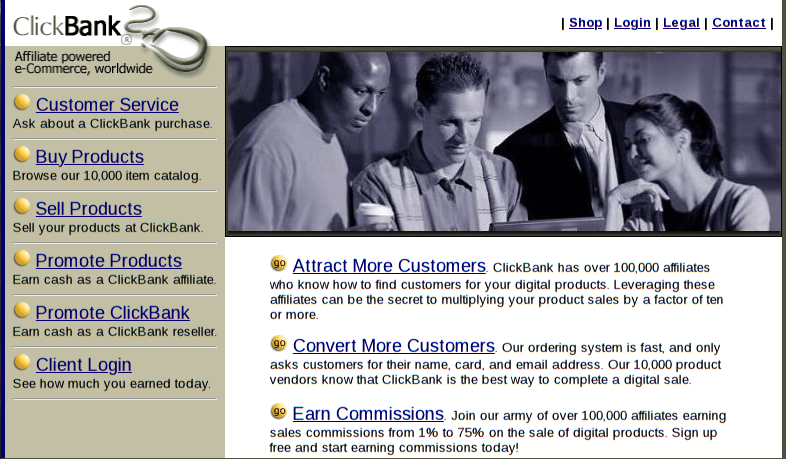
ClickBank in April 2006 — “10,000 item catalog” and “over 100,000 affiliates.” This is what I was building.
So It’s 2005…
Nobody had invented the term “full-stack developer” yet. But that’s what I was doing at ClickBank - the largest digital payment platform of its era. I was writing code, running the call center, researching fraud patterns, and honestly? I had no idea I was doing something that would eventually get its own job title.
Every day, millions of dollars flowed through the system. Credit card authorizations, settlements, refunds, chargebacks. Fifteen thousand merchants in two hundred countries, all selling digital products to customers who expected instant delivery and zero friction.
And everywhere - everywhere - fraud.
The Thing About Digital Goods
Here’s what makes digital goods different from physical stuff: there’s no trail.
Physical products leave evidence. Shipping addresses. Delivery confirmations. A package that actually arrives somewhere. If someone buys with a stolen card, you can at least try to recover the item.
Digital products? They vanish into the ether the moment someone clicks download. An ebook. A software license. A membership code. If a fraudster buys with a stolen credit card, the merchant has nothing to recover. The chargeback hits, and they’re out the money AND the product.
In the mid-2000s, digital goods fraud was absolutely rampant. The industry average chargeback rate was hovering around 2-3%. For every hundred transactions, two or three would come back as fraudulent. That doesn’t sound like much until you do the math on millions of daily dollars.
We got it down to 0.8%.
Way More Than Just Code
I didn’t just write the fraud detection system. I ran the call center.
When a merchant called because their account got flagged? I was on the phone with them. When a customer disputed a charge they didn’t recognize? I investigated it. When a new fraud pattern emerged (and they always did) - I researched it, documented it, and built the detection rules to catch it.
This wasn’t a problem you could solve by writing clever code in isolation. Fraud is adversarial. The attackers adapt. Every single time we closed one hole, they found another. The only way to stay ahead was to understand the full picture: the technology, the merchants, the customers, and yeah - the criminals.
I got pretty good at thinking like a fraudster. Not sure that’s something you put on a resume, but it’s true.
The Tightrope Nobody Talks About
Here’s the thing about fraud detection that most people completely miss: being too aggressive is just as bad as being too permissive.
The Fraud Detection Paradox
Block too many transactions → kill legitimate sales → merchants leave → revenue drops. Your fraud numbers look great but you’ve strangled the business.
Block too few → chargebacks pile up → payment processors threaten to cut you off → merchants lose money → everyone’s angry.
The art is in the balance. We achieved 98.5% fraud detection accuracy with less than 2% false positives. That’s the difference between a platform that grows and one that collapses under its own weight. And honestly, finding that balance was one of the hardest problems I’ve ever worked on.
Eight Years
I was at ClickBank for nearly eight years. The platform maintained 99.9% uptime. We processed over 50,000 transactions daily at peak. The fraud detection system I built - the research, the rules, the patterns I identified - protected millions of dollars and thousands of merchants.
This work eventually contributed to Kount, a fraud detection company that Equifax acquired in 2021. So that’s kind of wild - stuff I built in 2005 ended up getting acquired for serious money sixteen years later.
What Stuck With Me
Scale changes everything. A solution that works for a hundred transactions breaks catastrophically at ten thousand. A fraud pattern that’s obvious when you’re looking at individual cases becomes invisible in the noise. A single decision - approve or decline - plays out thousands of times a day.
And technology alone isn’t enough. The best code in the world won’t help if you don’t understand the humans on both sides of the transaction. The merchants trying to build real businesses. The customers just trying to buy something. The fraudsters trying to exploit both.
That’s what eight years at ClickBank taught me. Not just how to build systems that scale, but how to build systems that actually serve the people using them. Pretty foundational stuff, looking back on it…